
What the ancient Jain saint Bahubali taught me about pride, arrogance and ego
I climbed 600 steps to reach a 57-foot, 10th-century statue of Lord Bahubali, a Jain saint. What I found at the top was a lesson in humility.

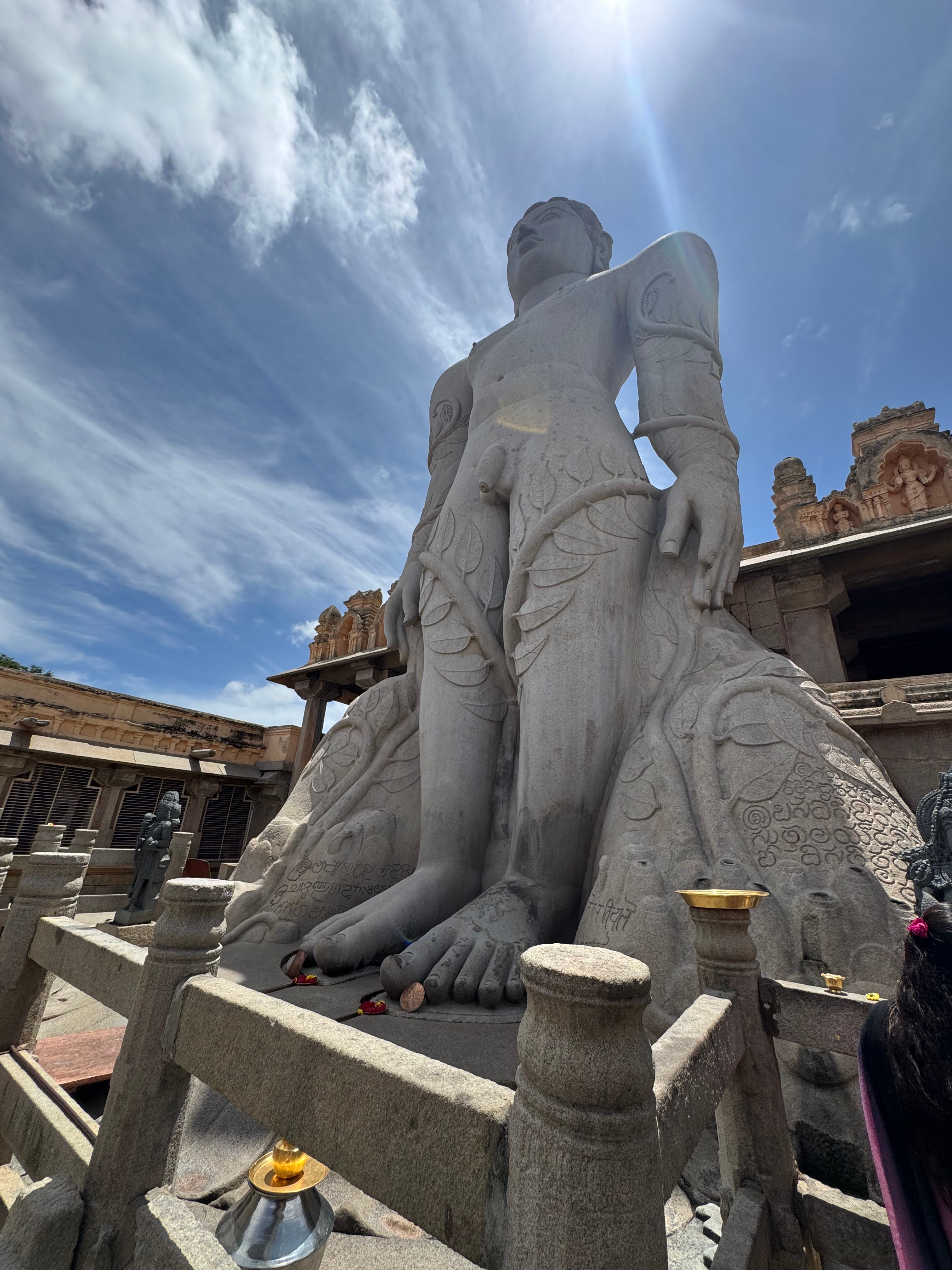
Amid the chaos of the present — brutal wars, mass starvation, and ceaseless violence around the world — I found an unexpected sense of respite sitting at the feet of a colossal 10th-century statue of the Jain saint Bahubali.
The pilgrimage site lies in the rural town of Shravana Belagola, about two and a half hours’ drive from the bustle of Bengaluru. The statue, approximately 57 feet tall, is carved from a single block of granite.
In Jain tradition, the saint is said to have meditated standing for 12 years. The towering statue captures him in that very posture: eyes closed, wholly withdrawn from the outside world, with creepers winding around his arms and legs. He is fully nude, in accordance with the Digambara Jain tradition, where extreme renunciation means discarding even clothing.
For those unfamiliar with Jainism: It is one of India’s oldest living spiritual traditions, with roots stretching back thousands of years. Jains follow the teachings of 24 Tirthankaras — “ford-makers,” or spiritual guides who show the way toward a life grounded in ethics and nonviolence.
My own practice, modest by comparison, largely consists of trying not to harm other living beings.
Visiting the site is also an encounter with history. The statue itself is attributed to the Ganga dynasty, which ruled parts of present-day Karnataka; inscriptions at the site confirm its consecration in 981 C.E.
Centuries before that, according to Jain tradition, Chandragupta Maurya — who ruled from roughly 320 B.C.E to 298 B.C.E as the founder of the Mauryan Empire — spent his final years at the site. Jain accounts hold that Chandragupta, who renounced his kingdom to become a monk, undertook sallekhana, the ritual fast unto death, at this very site.
For me, the climb up the six hundred steps to Vindhyagiri Hill was as much a test of the body as it was a meditation on the lives of world rulers — both legendary and historical — who pursued conquest, only to abandon it in the end. This is the story I write about — and what it has come to mean for me now.
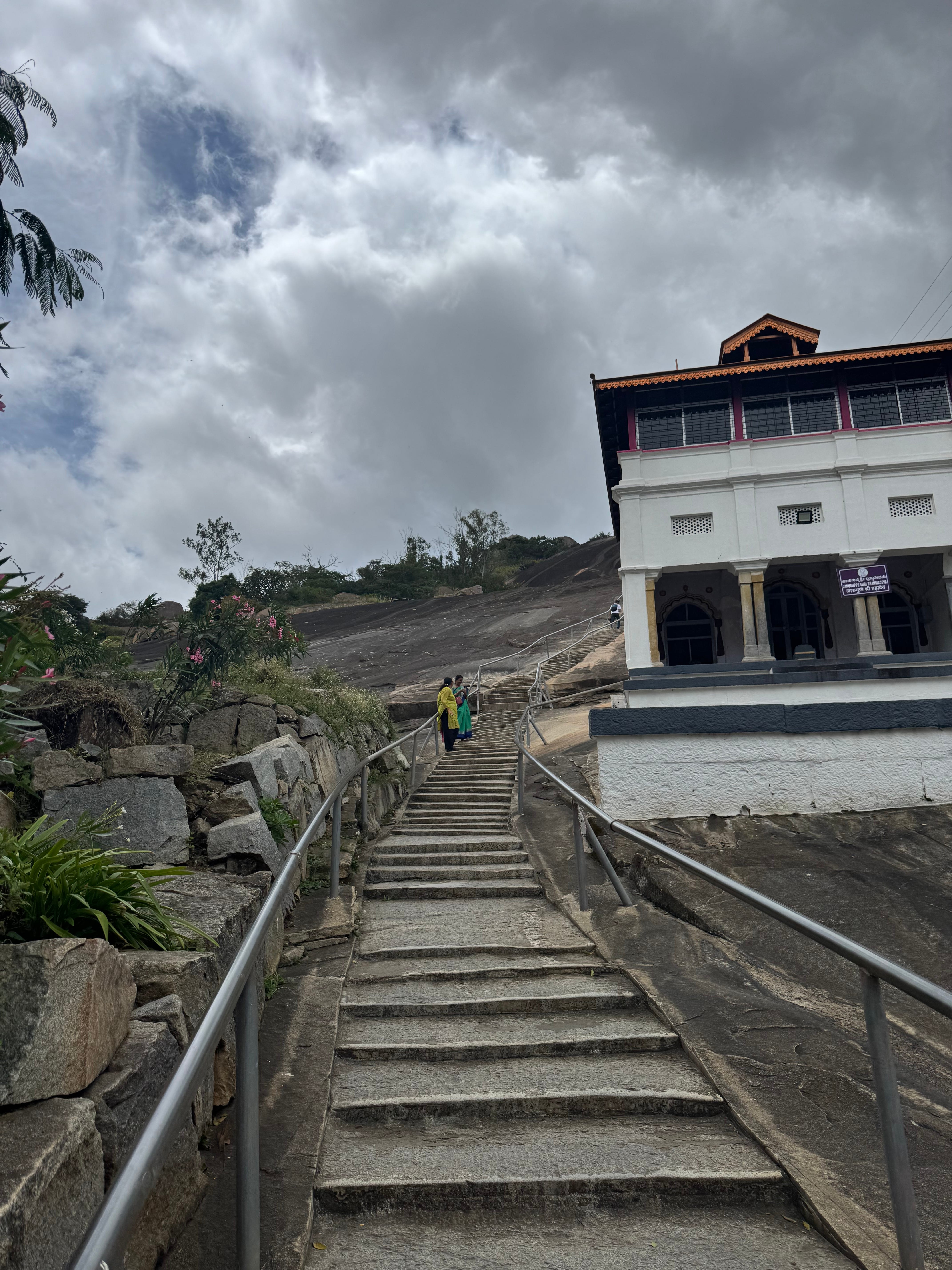
I will say this to my readers: this Substack itself is a slow read — like my journey. There are stories within stories here — much like the tradition. Each story has a moral message, and one needs to pause — just as I did on each step of this journey — to take it in.
The Legacy of Bahubali
I met the head of the mutt — the monastic institution — that oversees the pilgrimage site, Swastishri Shri Madha Abhinava Charukeerthy Bhattaraka, known as His Holiness Jagadguru. Seated on his gaddi — the seat of authority — and resplendent in saffron robes, he was unlike any 23-year-old I had ever encountered.
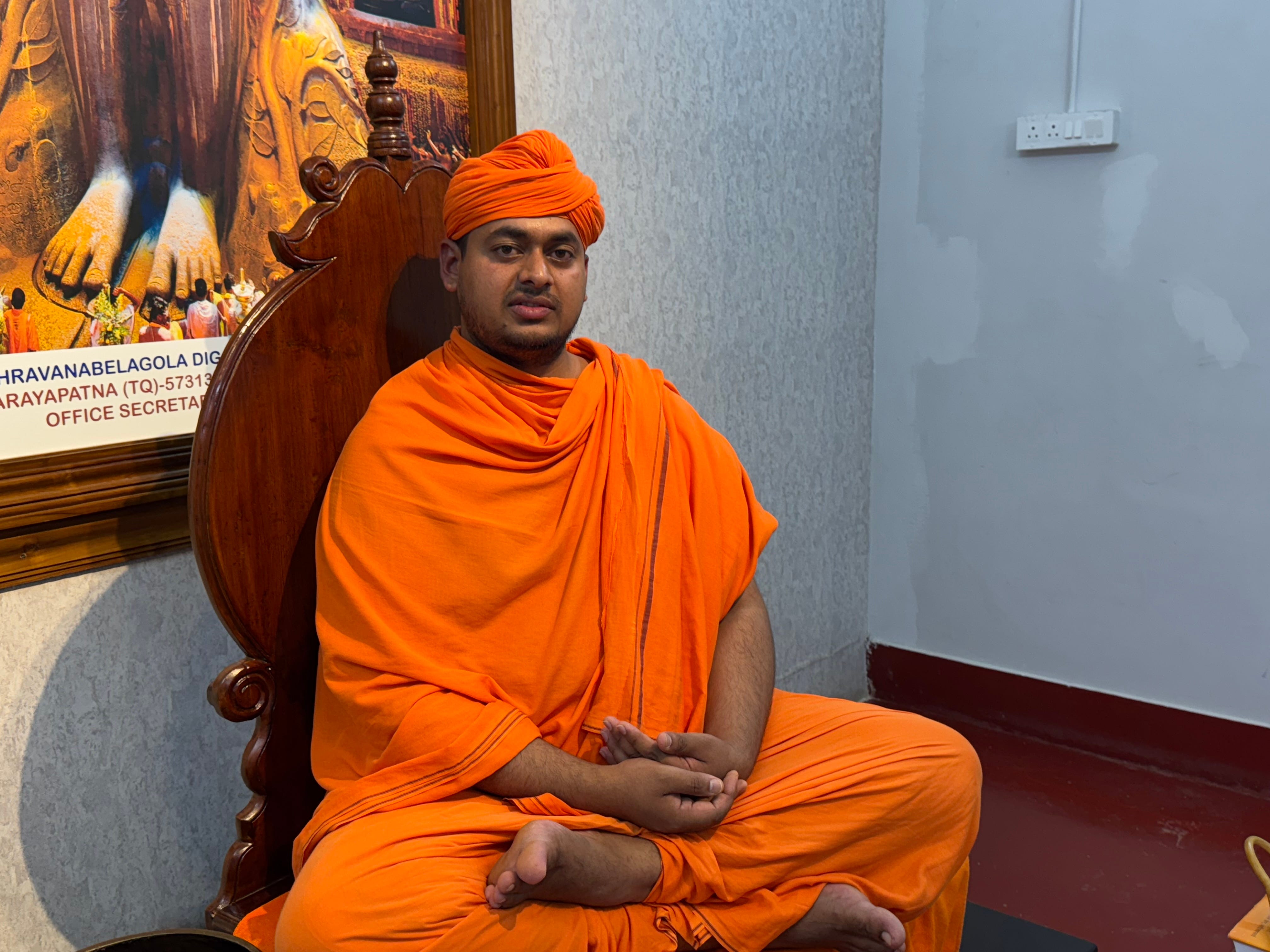
He explained the story — which I thought I already knew — but he unfolded for me the deeper history and symbolism of the site.
Bahubali, also known as Gommateshwara, was the son of Rishabhadeva (Adinath), who is revered as the first Tirthankara in the Jain tradition. He is believed to be the younger brother of Bharata — the universal sovereign after whom, Jains believe, the land of Bharata, that is India, takes its name.
The Adi Purana, composed by the ninth-century Jain acharya Jinasena — which I read as a theology student at Harvard Divinity School — recounts that Bharata claimed rights to the entire kingdom and demanded that his brothers surrender. Bahubali refused, and the two were drawn into a series of confrontations. Since they did not wish to harm their armies, the text explains that they engaged in three forms of nonviolent contests:
Jala Yuddha or Water War, which involves showering or spraying water on each other,
Drishti Yuddha or Vision War, which involves staring at one another without blinking
Malla Yuddha or Wrestling, the final physical encounter
In the final contest, Bahubali lifted Bharata before the assembled army, claiming victory. Yet in that moment, the weight of what he had done — fighting his own brother for the sake of land and kingdom — struck him profoundly. Overcome with remorse, he stripped off his royal garments and withdrew into the forest to undertake penance.
For 12 years, he stood unmoving. Adi Purana describes how even the natural world around Bahubali transformed in profound ways because of his presence: lions and deer drank from the same stream, and animals lived without fear.
Yet even after such extreme penance, the thought that he was still standing on his brother’s land prevented him from attaining moksha — liberation from the cycle of birth and death. Only when Bharata himself bowed at Bahubali’s feet was that final barrier removed, opening the way to liberation.
This 12-year standing meditation is unique even among Jain Tirthankars, who go through extreme penance.
History, Legends, and an Extraordinary Contract
Jagadguru explained that Shravana Belagola has been a center of Jain monastic life for over two millennia. During a prolonged famine in northern India around the fourth century B.C.E., the Jain monk Acharya Bhadrabahu is said to have migrated to Chandragiri Hill, adjacent to the Vindhyagiri Hill where the statue of Bahubali rests, with thousands of monks.
Inscriptions on cave temples record the patronage of rulers from several dynasties that ruled the region. During my visit, I found several such inscriptions and markings.
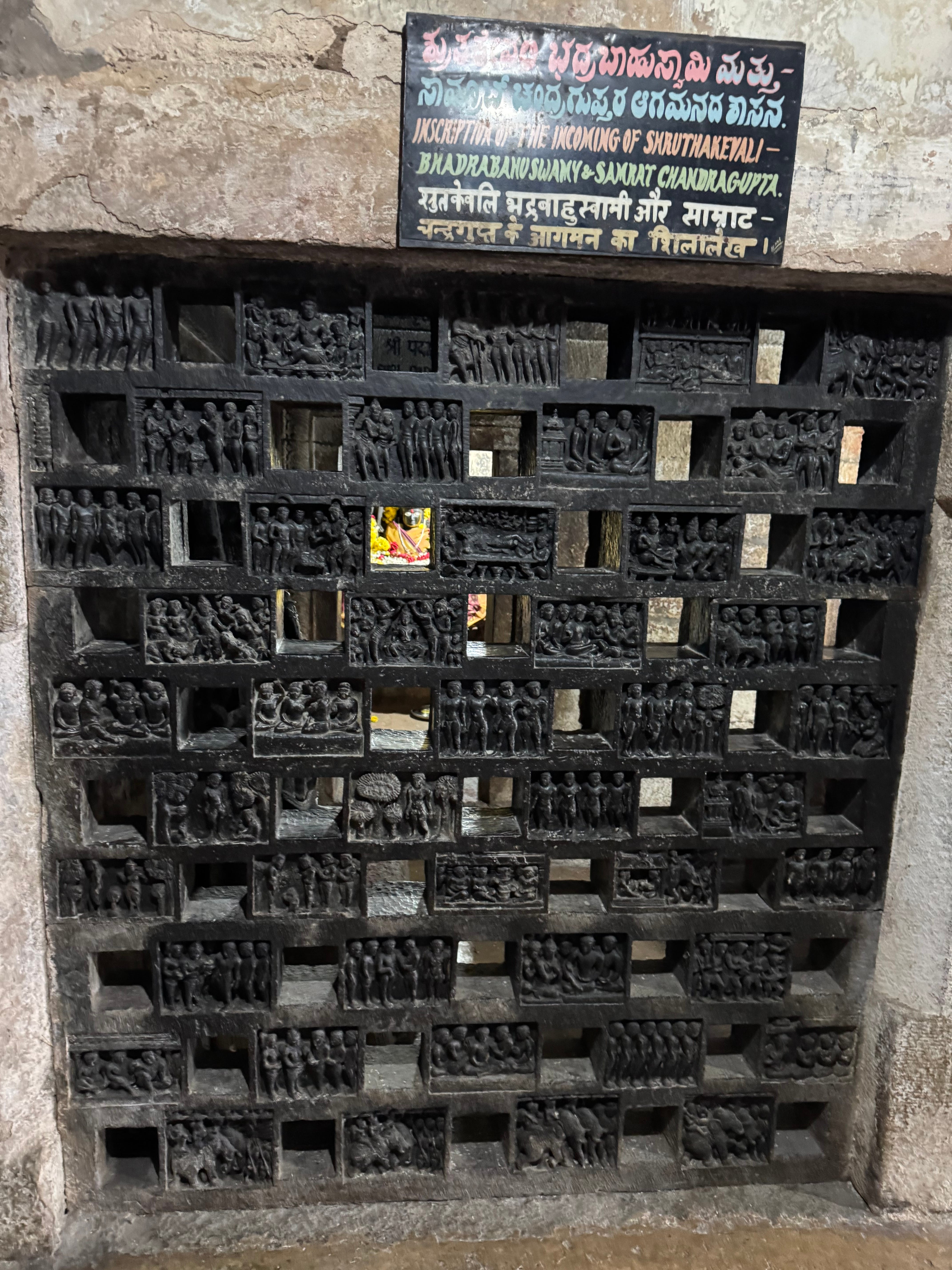
Footprints attributed to Chandragupta Maurya exist along a forested and protected pathway near the hill, Jagadguru explained. However, the terrain is rough, and wild animals may also be present along this path. Physically exhausted from the difficult climb and barefoot — as required for the ascent — I was unable to visit it.
But the physical strain did not keep me from attending to the many stories and legends of this site — each revealing human flaws of pride and ego, while also teaching lessons of humility and blindness to our own faults.
One such story recounts that Chamundaraya (also spelled Chavundaraya), the Ganga dynasty general who commissioned the statue, was guided to the task through a dream that came to both him and his mother, Kalala Devi, a devout Jain.
In the dream, a yakshi — a celestial being named Kushmandini Devi — instructed Chamundaraya to release an arrow from Vindhyagiri Hill. The site where the arrow struck would reveal the precise location for Bahubali’s statue.
Legend has it that the arrow struck the granite hilltop, revealing the outline of the figure. Carving the statue took over a decade.
It is believed that the renowned sculptor Arishta Nehmi carved the statue directly from the mountain itself. The story of the contract between Chamundaraya and the sculptor — as Jagadguru explained — was “much like how contracts are made today when building a house.” The agreement, however, was extraordinary: for every amount of stone that was cut away, an equal weight of gold was to be paid.
Each day, stone dislodged from above would tumble down the hillside. It could not simply be discarded; it had to be carried back up and accounted for. Day after day, for 12 years, the sculptors repeated this cycle of cutting the mountain and moving the stone with meticulous devotion.
The Consecration and Ego
The statue of Bahubali is said to be unparalleled in scale and beauty — flawless, with no visible defect. According to Jain tradition, the statue embodies three rare qualities at once: beauty, determination, and spiritual presence. As Jagadguru said, “Nothing like it has been created anywhere else in the world.”
Predictably, Chamundaraya was filled with pride at the achievement. But when he performed the consecration ritual, the Mahamastakabhisheka, the story goes that no matter how much water or sacred substance was poured, it would not flow from the head.
Then the celestial being Kushmandini Devi appeared again in a dream — this time as an old woman. She instructed that the abhisheka be performed using a small pot.
She performed the abhisheka herself. That single, humble pot replaced the grandeur of Chamundaraya. Through devotion and humility, it is believed, the entire statue — and even the surrounding mountain — was bathed in sacred nectar. Milk flowed across the statue and collected in the pond below.
From this tradition comes the name Belagola. In Kannada, bili means white and kola means pond. Shravana means “ascetic,” hence Shravana Belagola.
The Mahamastakabhisheka — a mesmerizing ceremony — is performed every 12 years. Milk, water, turmeric, vermilion, and other sacred substances are poured over the statue from the head as part of the ritual.
What I Learned
There is no ropeway to the top of Vindhyagiri Hill. Those unable to climb must be carried in a doli — a palanquin borne by four men.
For those of us still able, ascending the more than six hundred steep steps on foot becomes, almost inevitably, a meditative act: patience with the body, and patience with the mind’s insistence on speed.
What stands at the summit is the story of a conqueror told twice — once in flesh, once in stone. Bahubali was born a prince, not immune to ambition, conquest, doubt, or attachment. He struggled with ego and power, even against his own brother, Bharata.
It is a deeply human story, and its spiritual force lies precisely in that conflict.
The site repeats these lessons of power, ego, and renunciation again and again — across centuries, through different lives.
Chandragupta Maurya, who once held vast power and wealth, is said to have relinquished everything here. He was the grandfather of Emperor Ashoka — another ruler who sought to conquer the world, only to renounce violence after witnessing the devastation it caused, turning instead toward the spread of Buddhism.
Then there is Chamundaraya, the general who commissioned the statue itself — reminded by a celestial being that humility, not patronage, is the true prerequisite of devotion, and that arrogance and ego must be dismantled for spiritual progress.
The lessons from this journey are still unfolding for me. In the vastness of Bahubali’s presence, I felt my ego loom large, while my physical self felt small — almost insignificant.
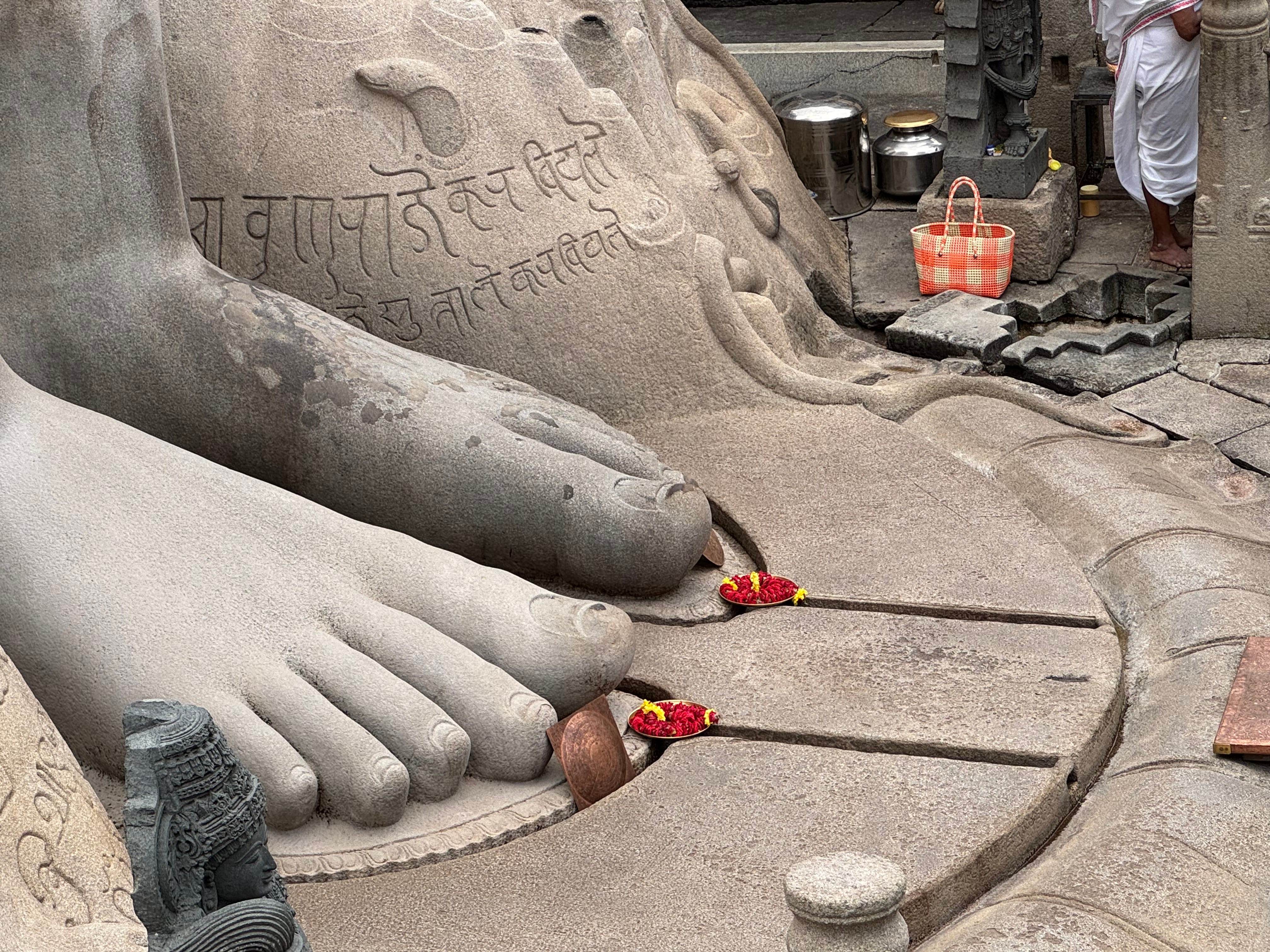
Bowing at Bahubali’s feet, I felt moved to set that ego aside.
Yet I also know from experience that ego does not dissolve so easily. Renunciation rarely arrives all at once, if at all it does; it unfolds slowly — day by day, act by act.
It takes sacrifice, and sacrifice is hard. As Jagadguru explained to me, sacrifice does not mean giving away what you do not need. It means giving up what you believe is truly yours.
That is what Bahubali demonstrated — not through force, but through nonviolence. His liberation did not arise from power or glory, but from his ability to transcend them.
This writing is merely my attempt to make those lessons stay with me — and, I hope, with you as well.
The layers of wisdom unfurled in the telling of these stories will stay with me long past by slow reading of them. What an extraordinary visit you had and your ability to climb the 600 steps is remarkable. Thanks for sharing this journey with us.
Awesome. I'm off to do the 600 steps. look forward to more of your reporting.